Monday, March 25, 2013

THEY CALLED THEMSELVES THE K.K.K: THE BIRTH OF AN AMERICAN TERRORIST GROUP


Bibliographic Information:  Bartoletti, Susan Campbell. They Called Themselves The K.K.K : the Birth of an American Terrorist Group. 2010. New York, NY : Houghton Mifflin. ISBN 978-0-618-44033-7.
 
 
Summary:
The book details the beginnings of the Ku Klux Klan in Pulaski, TN during the Reconstruction Era (1865-1877) of US history.  After the slaves were emancipated, groups of whites in the American south secretly banded together and terrorized them and their white supporters.  KKK activities spread across the south and persisted through much of the 20th century, slowing over the last few decades as the civil rights movement flourished. 
 
 
Critical Analysis:
Bartoletti is a Sibert Medel winning, Newbery Honor author with sixteen books to her credit.  She has exhaustively researched the subject of the birth and history of the Ku Klux Klan and provides a steady, factual, non-emotional narrative that provides the facts and lets readers judge for themselves.  Resources accompanying the narrative include a six page Civil Rights Time Line, five pages of information on all the quotes provided throughout the book, seven pages of bibliographic and source notes and a three page index. 

Though the book doesn’t read as much like a fiction story as many informational books for youth do these days, it is still very inviting especially due to the number and variety of the illustrations accompanying the narrative.  Hardly a page goes by that a detailed illustration doesn’t help readers really “see” the story coming to life before them.  It’s an interesting story that encourages readers to ruminate on the Klan’s history as well as its current state and future and to perhaps be curious and intrigued enough to continue reading about the subject.  By calling the Klan an “American terrorist group,” readers are perhaps challenged to re-evaluate what their own definitions of being a “terrorist” really are.
 
 
Book Review Excerpts:
“This richly documented, historically contextualized account traces the origin and evolution of the Ku Klux Klan from a small mischievous social club into a powerful, destructive organization…Bartoletti effectively targets teens with her engaging and informative account that presents a well-structured inside look at the KKK, societal forces that spawn hate/terrorist groups, and the research process.”  - Gerry Larson, Durham School of the Arts, NC (Reviewed August 1, 2010 in School Library Journal (vol 56, issue 8, p117).

“Bartoletti expertly weaves together original sources, testimony, newspaper accounts, with plenty of photographs and illustrations. to paint a portrait of terrorism. It’s a nice mix of primary sources to tell a story…” Elizabeth Burns in School Library Journal, Jan. 4, 2011 (from http://blogs.slj.com/teacozy/2011/01/04/review-kkk/)
 
 
Awards:
ALA Notable Children's Books - Older Readers Category: 2011
Booklist Editors' Choice - Books for Youth - Older Readers Category: 2010
School Library Journal Best Books: 2010
Nominated for the YALSA Award for Excellence in Nonfiction for Young Adults.
 
 
Connections/Further Activities:
Incorporating excerpts from age-appropriate documentaries about the K.K.K – its formation and history – would help to vividly portray the group’s terrorist activities and its dark place in history.

Initiate a discussion of what students think makes a “terrorist” and why or why not the Klan fits this definition.
 
 
Title Read-A-Likes:
Superman Versus the Ku Klux Klan : the True Story of How the Iconic Superhero Battled the Men of Hate - Rick Bowers
1963 Birmingham Church Bombing : the Ku Klux Klan's History of Terror - Lisa Klobuchar
The Return of Gabriel – John Armistead
The Legend of Buddy Bush – Sheila P. Moses
Witness – Karen Hesse
When I Crossed No-Bob – Margaret McMullan

THE GIANT AND HOW HE HUMBUGGED AMERICA


Bibliographic Information:  Murphy, Jim. The Giant and How He Humbugged America. 2012. New York, NY : Scholastic Press. ISBN 978-0-439-69184-0.

Summary: 
In 1869, the “Cardiff Giant” – a purported ten-foot-tall "petrified man" – was reported to have been discovered in the upstate New York town of Cardiff.  Many experts were called in to determine if the giant was an actual man or a statue but they couldn’t agree. Thousands came to see for themselves the amazing giant upon hearing about it by word of mouth and newspaper reports.

Critical Analysis:
Jim Murphy has written 35 books (both fiction and nonfiction) for children and young adults, including more than 30 about American history.  He received the annual Margaret A. Edwards Award from the American Library Association in 2010, recognizing his cumulative "significant and lasting contributions to young adult literature.”  He has been a runner-up for the annual Newbery Medal twice and has won the Sibert Medal as well as three Orbis Pictus Awards, three Jefferson Cup Awards, two SCBWI Golden Kite Awards, The Washington Post/Children's Book Guild Award for Distinguished Nonfiction, and the Boston Globe-Horn Book Award.  He is certainly an expert in his field and The Giant and How He Humbugged America is simply one more example of his well-researched and interesting stories.

The book contains nine pages of source notes, two full pages of bibliographical references, a page of photo credits and a three page alphabetical index.  Even as Murphy exhaustively details his sources and backs up his research, he gives us a narrative that reads like a good fiction story.  He breaks each part of the timeline down into manageable parts and even provides a “cast of characters” in the first few pages.  The layout is ideal for skimming.  If a reader is only interested in the discovery of the Cardiff Giant, the truth of what was finally determined or the aftermath of the story, each chapter is clearly divided and labeled for easily finding just the part of the story readers need.

The photographs throughout the book are fascinating.  Hardly one page goes by where there isn’t a photo or two to vividly illustrate the story.  These, along with the cover illustration, make the book very inviting and encourage curiosity about just what the true dish on the “giant” was. Murphy writes in the style of a good mystery, never revealing the truth until the appropriate part of the story so that readers are curious and trying to figure out the end as they read.  This book is a wonderful example of what fun, interesting informational books for young readers should be.

Book Review Excerpts:
“Contextualizing this scam against the wider backdrop of the Gilded Age, Murphy adeptly explains how hoaxes like the Cardiff Giant helped accelerate reforms, such as the establishment of professional scientific organizations and journals.”  Staff (Reviewed September 17, 2012 in Publishers Weekly (vol 259, issue 38).

“A generous mix of newspaper illustrations, carnival posters and photographs lend a period feeling to the thoroughly engaging volume. After reading this fascinating story, young people will appreciate the old expression, spawned by this very hoax, "There's a sucker born every minute." - Kirkus Reviews, September 1, 2012.

A “fun, exciting, and lively account.”  - Susan Shaver, Hemingford Public Schools, NE.  Reviewed September 1, 2012 in School Library Journal (vol. 58, issue 9, p165).

Awards:
The title doesn’t appear to have won any awards though it’s author, Jim Murphy, has won the Sibert Medal, is a Newbery Honor author and has been nominated for the Dorothy Canfield Fisher Children's Book Award and the National Book Award for Young People's Literature. 

Connections/Further Activities:
Students could discuss other such famous hoaxes in U.S. and world history. Murphy provides a list of them at the back of the book that would be a great starting point. 

Title Read-A-Likes:
Terracotta Army and Other Lost Treasures – John Malam
Fooled you! – Elaine Pascoe
Duped! – Andreas Schroeder
The Curse of King Tut's Tomb and Other Ancient Discoveries – Anita Ganeri

WALT WHITMAN: WORDS FOR AMERICA


Bibliographic Information:  Kerley, Barbara. Walt Whitman: Words For America. 2004. Ill. by Brian Selznick. New York, NY : Scholastic Press. ISBN 0-439-35791-8.

Summary: 
The book is a picture-book biography of one of America’s most famous and respected poets.  It focuses on his youth and his years of serving as a nurse to injured and dying Civil War soldiers.  Readers will see Whitman’s passion for words, his country and the ordinary people who populate it. 

Critical Analysis:
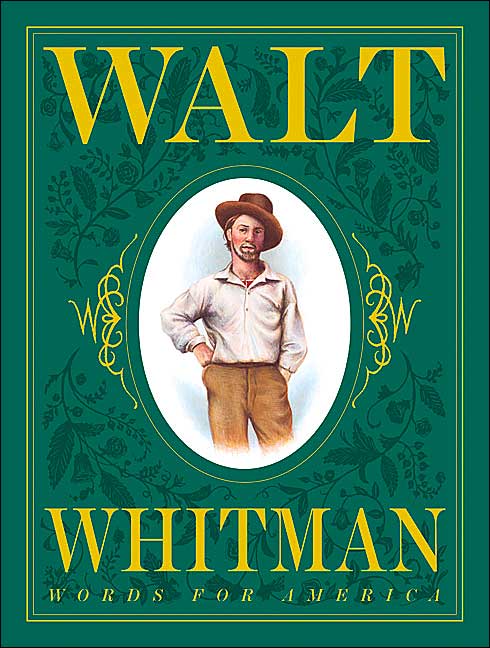
Author Barbara Kerley is a Sibert Informational Book Medal winner for her 2009 book “What to Do About Alice?:  How Alice Roosevelt Broke the Rules, Charmed the World, and Drove Her Father Teddy Crazy!”  She has written several informational books for children and is recognized as a reputable author in her field.  Walt Whitman: Words for America is a very interesting biography that is presented as lively and fun, with many beautiful illustrations by Brian Selznick – himself a Caldecott Medal winning illustrator and an author. 

From the book’s cover – which features an iconic image of Whitman in a cut-out style portrait – through the last page, we see a logical, clear sequence of lovingly detailed illustrations of Whitman’s life.  First, he is a young typesetter, later a volunteer nurse with Civil War soldiers and on battlefields and finally we see Whitman struggling with President Lincoln’s assassination as the rest of the country was.

The narrative of Whitman’s life is simple and straightforward and the author doesn’t overwhelm readers with facts in the body of the book.  Following the story, however, we are provided with extensive notes on Whitman, Lincoln and the era of (and after) the Civil War.  Selznick also includes a long note and then we see several of Whitman’s poems with notes.  A long list of sources and quotes used is further included.

The book is a wonderful introduction to Whitman.  We see him in all his humanity and are introduced to the best of his works.  Beautiful illustrations complement the narrative and the easy flow of the story makes it read like fiction in that it’s fun and entertaining.  Should readers wish to know more about Whitman, Lincoln and/or the Civil War, the extensive notes and resources listed will send them onward well-prepared to do just that.

Book Review Excerpts:
“Delightfully old-fashioned in design, its oversized pages are replete with graceful illustrations and snippets of poetry. The brilliantly inventive paintings add vibrant testimonial to the nuanced text.” - Marilyn Taniguchi, Beverly Hills Public Library, CA -- Reviewed November 1, 2004 in School Library Journal (vol 50, issue 11, p166)

“Selznick's versatile illustrations encompass a stark realism…and surreal whimsy…Copious quotes from his poems and correspondence let Whitman's eloquent voice resonate through the pages, and bountiful source notes remove any doubt of these talented collaborators' affection and admiration for their subject—their enthusiasm is convincing and contagious.” – Staff.  Reviewed October 18, 2004 in Publishers Weekly (vol. 251, issue 42, p64).

“A cultural force rendered with power and immediacy for a new generation.” - Kirkus Reviews, September 15, 2004.

Awards:
ALA Notable Children's Books - Middle Readers Category: 2005
New York Times Best Illustrated Children's Books: 2004
Parents' Choice Awards - Nonfiction: 2004
School Library Journal Best Books: 2004

Connections/Further Activities:
Follow up with more information on President Lincoln, the Civil War and Whitman’s own poetry.  Reading about these subjects or even screening excerpts from age-appropriate documentaries would help bring the experiences of Whitman’s life “home” to students.

Title Read-A-Likes:
Voice From Afar – Tony Johnston
Emily Dickinson's Letters To The World – Jeanette Winter
Carl Sandburg – Penelope Niven
Coming home – Floyd Cooper