Tuesday, April 23, 2013

TALES FROM OUTER SUBURBIA


Bibliographic Information:  Tan, Shaun. Tales From Outer Suburbia. 2008. New York, NY : Arthur A. Levine Books. ISBN 978-0-545-05587-3.

Summary:
The book consists of fifteen fantastical, illustrated short stories (some humorous and some haunting)set in the Australian suburbs.

Critical Analysis:
Tales From Outer Suburbia contains a wide variety of stories.  Some are funny, some are touching and some are tales universally true, with morals from which we all could learn some good lessons.  "Alert But Not Alarmed" is a shining example of that latter type.  In it, Tan imagines a future where "every household has its own ballistic missile" because everyone needs to be a part of "upholding national security" in an "increasingly dangerous climate."  To make the best out of a strange situation, people begin to paint the backyard missiles bright colors, string them with Christmas lights, and use them for storage, pet kennels and even pizza ovens.  Talk about making lemonade out of lemons!  The final paragraph of the story tells how they hope that, if families in faraway countries also have backyard missiles, hopefully they have found a much better use for them too.  That's an anti-war statement with cleverness, not moralizing or preachiness.

Some of the best (and most easy to identify with) characters are not human.  The dogs in "Wake" band together to exert vengeance over a neighborhood man who had beaten his dog to death earlier in the week.  The man's home burned, they surrounded him as if claiming his rescued property as their own and then proceeded to urinate on all he had left while loudly moaning and mourning the fate of their fallen canine comrade.  In "Eric," a leaf-like creature comes to visit and is always yearning to learn the "why's" of everything.  The artwork in this story is amazing, with his miniature frame against seemingly giant postage stamps, popcorn and poker chips.  These characters aren't human readers will like them, relate to them and cheer them on.  Tan's creativity in these stories and the others keeps readers turning the pages quickly.

No matter how odd some of the stories and characters may initially seem, we find universal themes of love, joy, loyalty and peace running throughout them all.  The amazing variety of both black and white and color illustrations greatly complements the weirdly fun tales.

Book Review Excerpts:
"The thoughtful and engaged reader will take from these stories an experience as deep and profound as with anything he or she has ever read." - Jesse Karp (Reviewed 12-01-2008 in Booklist, Vol. 105, number 7, p. 50).

"Ideas and imagery both beautiful and disturbing will linger."  -  Staff (Reviewed November 3, 2008 in Publishers Weekly, Vol. 255, issue 44, p. 59).

"Graphic-novel and text enthusiasts alike will be drawn to this breathtaking combination of words and images."  - Kirkus Reviews, January 1, 2009.

Awards:
Adelaide Festival Awards (Australia): Children's Literature
ALA Notable Children's Books - Older Readers Category: 2010
Booklist Editors' Choice - Books for Youth - Older Readers Category: 2009
Children's Book Council of Australia: Children's Book of the Year Awards: Older Readers
Children's Book Council of Australia: Notable Australian Children's Books: Older Readers
Children's Book Council of Australia: Notable Australian Children's Books: Picture Books
New York Times Best Illustrated Children's Books: 2009
Parents' Choice Awards - Fiction: 2009
USBBY Outstanding International Books - Grades 6-8: 2010
Western Australian Premier's Book Awards: Young Adult's Books

Connections/Further Activities:
Have students to compose a short story that's kind of out-of-the ordinary like the ones in Tales From Outer Suburbia.  Ask a couple willing volunteers to read their's aloud to the class.

Show short segments from a documentary film on the areas of Australia referred to in Tales From Outer Suburbia to give students a true vision of what life looks like there.

Read-A-Likes:
The eternal smile : three stories - Gene Luen Yang and Derek Kirk Kim
The storm in the barn - Matt Phelan
Hereville : how Mirka got her sword - Barry Deutsch/colors by Jake Richmond
Laika - Nick Abadzis/color by Hilary Sycamore
The savage - David Almond/illustrated by Dave McKean


FEATHERS

Bibliographic Information:  Woodson, Jacqueline.  Feathers. 2007. New York, NY : G.P. Putnam's Sons. ISBN 0399239898 .

Summary:
It's 1971 and Frannie is a sixth grade student at a predominantly African-American middle school.  When a new white student nicknamed "The Jesus Boy" begins attending, Frannie's friendship with him makes her start to have a different view of life. 

Critical Analysis:
Feathers was a really interesting novel to me as its setting is 1971 and I myself grew up in the seventies.  Much like Frannie, I also attended a school that was all one race and can relate to the feelings that some of her classmates had when someone they considered very "different" suddenly entered their midst. 

Discussion of race plays a major part in this novel.  The "Jesus Boy" is white as snow but has black (adoptive) parents.  The class bully, Trevor, who calls Jesus Boy "white boy," is himself biracial and light-skinned.  Even though the classmates can be pretty disrespectful of each other and their respective backgrounds, Woodson writes about both races in a respectful, understanding manner.  Readers can empathize with "Jesus Boy" and the love he feels for his parents even though they do not share the same racial background.

Religion is another subject Woodson delves into in the novel.  The "Jesus Boy" is quiet, calm and patient thoroughout most of the novel and Frannie's friend, Samantha, even comes to believe he may be the Christian savior.  Frannie has been studying the Emily Dickenson poem that states "hope is a thing with feathers/that perches in the soul" and, when she sees the Jesus Boy's effect on his classmates, she almost begins to believe Samantha may be right.  That changes when he has a hateful confrontation with Trevor and she sees that his is human and makes mistakes like everyone else.

Frannie's home and family, including a deaf brother, are full of love and laughter.  She wrestles with despair at her brother's issues as well as the three miscarriages her mother - who is now pregnant again - has had.  Frannie questions her own prejudices, her own beliefs and, in the end, the novel ends on a hopeful note that things are going to be alright for her.

Book Review Excerpts:
"With her usual talent for creating characters who confront, reflect, and grow into their own persons, Woodson creates in Frannie a strong protagonist who thinks for herself and recognizes the value and meaning of family. The story ends with hope and thoughtfulness while speaking to those adolescents who struggle with race, faith, and prejudice. They will appreciate its wisdom and positive connections." - D. Maria LaRocco, Cuyahoga Public Library, Strongsville, OH. Reviewed April 1, 2007 in School Library Journal - Vol. 53, issue 4, p. 152.

"Set in 1971, Woodson's novel skillfully weaves in the music and events surrounding the rising opposition to the Vietnam War, giving this gentle, timeless story depth. She raises important questions about God, racial segregation and issues surrounding the hearing-impaired with a light and thoughtful touch."  Charlotte Sheedy - Staff (Reviewed January 8, 2007 in Publishers Weekly Vol. 254, issue 2, p. 51).

"Woodson captures perfectly the questions and yearnings of a girl perched on the edge of adolescence, a girl who readers will take into their hearts and be glad to call their friend." - Kirkus Reviews, February 1, 2007).

Awards:
ALA Notable Children's Books - Older Readers Category: 2008
Oprah's Kids' Reading Lists - New Releases: 10-to-12 Years

Connections/Further Activities:
Share short segments of age-appropriate documentaries about the Vietnam War-era/early 1970's to give students a "feel" for the time period Feathers is set in.

Discuss what it must feel like to be the only one of a certain group (race, sex, religion) in a group of those different from them.  Ask students if they've ever experienced that personally or encountered it in school or social groups and have them describe the situation.  This can lead to a discussion on acceptance on those different from us and anti-bullying efforts.

Read-A-Likes:
Keeping Safe the Stars  - Sheila O'Connor
Coming On Home Soon - Jacqueline Woodson
Next-Door Neighbors - Sarah Ellis
Gold Dust - Chris Lynch
Under the Blood-Red Sun  - Graham Salisbury


Monday, April 22, 2013

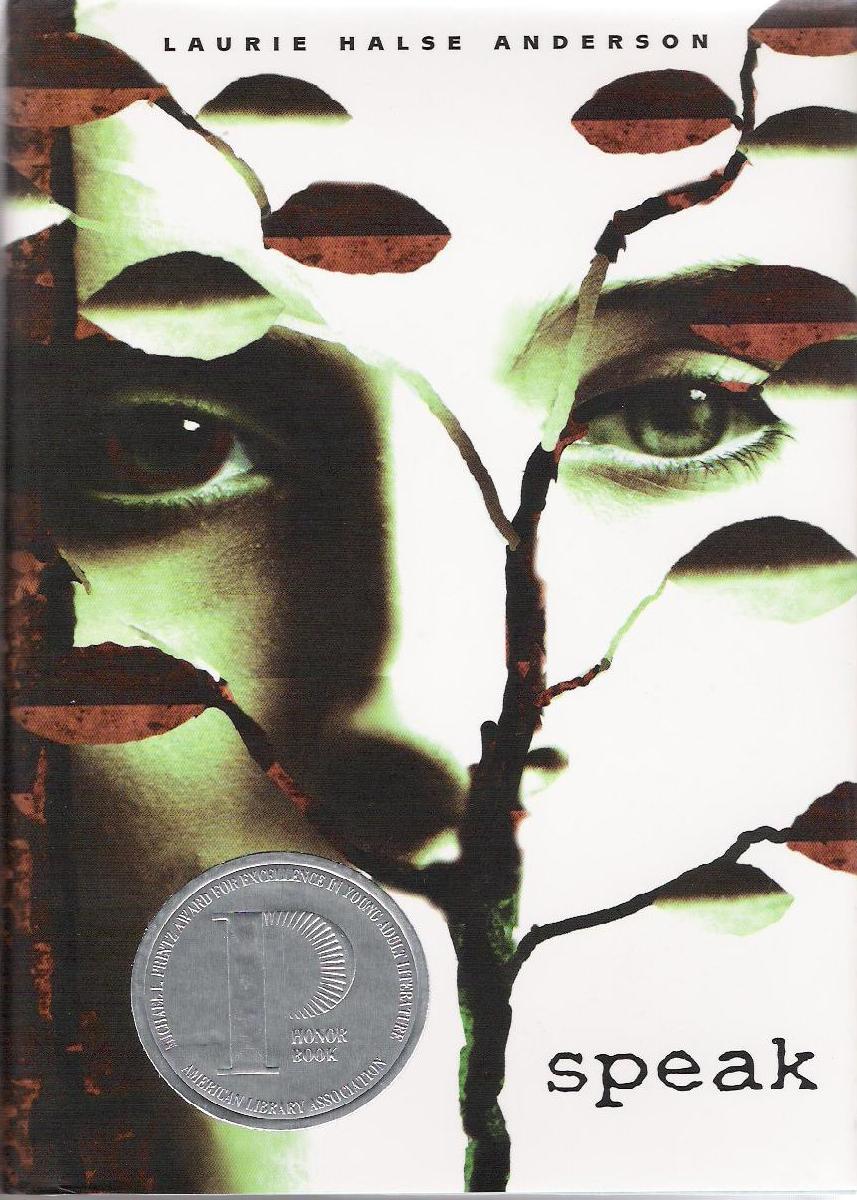
SPEAK


Bibliographic Information:  Anderson, Laurie Halse. Speak. 1999. New York, NY : Farrar Straus Giroux. ISBN 0374371520.

Summary:
At an end-of-summer party before she begins high school, Melinda is raped by a popular senior.  Though she doesn't report it, a call to the police breaks up the party and makes her a pariah at school.  With the help of an empathetic teacher, she comes to grips with what happened to her and regains her inner strength.

Critical Analysis:
Melinda's story is very believable, almost painfully so.  It is easy - especially as an adult who has been through high school and come out on the other side - to relate to the pain she feels as she loses the companionship of all those she once considered her friends and becomes an outcast, accepted by no social group.  One can almost feel the claustrophobia of being back in high school, judged by classmates for doing something they don't even understand. This feeling of not belonging is a universal one with which most readers are likely to empathize.

It is easy to relate to Melinda, even never having suffered an assault as she did.  As we are privy to her internal pain and the emotional growth she experiences, we as readers root for her to be vindicated and become popular.  In the novel's final pages as she tells her former friend and classmates about the rape and sees an outpouring from other girls about their own experiences with her attacker, she begins to become more confident and assertive.  When he attempts to assault her a second time, she fights him off and is finally able to talk about what happened.  The novel, thus, ends on a positive, hopeful note.  It's not a neat and tidy ending, all happy and tied up in a bow.  It's left open for readers to decide what eventually happens with Melinda but we know that Andy no longer has any power or control over here because the truth is out and she's talking and working through it.  We can be confident that she is going to be alright.

The story really keeps readers turning the page, wanting to know what's going to happen next.  It's a realistic story with believable dialogue.  Readers can actually imagine themselves in a modern-day high school in the midst of these conversations and interactions.  The characters don't always behave as we may want them to but they do behave in ways we can belive teenagers would.  The author does not moralize in Speak.  There is no indication that Melinda is to blame for being at such a party to begin with.  Readers are shown that she is just an average freshman kid, at the party with many others like herself, who was attacked by Andy for no reason other than he wanted to do so and thought she was weak prey.  By story's end, we all know she was not.


Book Review Excerpts:
"In her YA fiction debut, Anderson perfectly captures the harsh conformity of high-school cliques and one teen's struggle to find acceptance from her peers. Melinda's sarcastic wit, honesty, and courage make her a memorable character whose ultimate triumph will inspire and empower readers."  (Reviewed September 15, 1999) - Debbie Carton.
"Anderson expresses the emotions and the struggles of teenagers perfectly. Melinda's pain is palpable, and readers will totally empathize with her. This is a compelling book, with sharp, crisp writing that draws readers in, engulfing them in the story." -Dina Sherman, Brooklyn Children's Museum, NY.  Copyright 1999 - Cahners Business Information.

"The plot is gripping and the characters are powerfully drawn, but it is its raw and unvarnished look at the dynamics of the high school experience that makes this a novel that will be hard for readers to forget." - Kirkus Reviews, September 15, 1999.

Awards:
  • Booklist Editors' Choice - Books for Youth - Older Readers Category: 1999
  • Carolyn W. Field Award (Pennsylvania)
  • Golden Kite Award: Fiction
  • Heartland Award for Excellence in Young Adult Literature (1996-2010)
  • School Library Journal Best Books: 1999
  • Sequoyah Book Awards (Oklahoma): Young Adult Books
  • South Carolina Book Awards: Young Adult Books

  • Connections/Further Activities:
    Have students discuss a time when either they or a classmate seemed to be an outcast.  Discuss how that person was treated by the group and why such ostracizing behavior is akin to -if not outright- bullying. 

    Lead a further discussion on bullying and all the recent anti-bullying efforts.  Have students discuss something they or other classmates have done to fight bullying in their school or social groups.

    Read-A-Likes:
    Just listenSarah Dessen
    Please Ignore Vera Dietz - A.S. King
    Inexcusable - Chris Lynch
    Safe - Susan Shaw
    The Mockingbirds - Daisy Whitney

    Wednesday, April 10, 2013

    BREAKING STALIN'S NOSE


    Bibliographic Information: Velchin, Eugene. Breaking Stalin’s Nose. 2011. New York, NY : Henry Holt and Company, LLC.  ISBN 978-0-8050-9216-5.

    Summary:
    During the time of Stalin’s rule in the Soviet Union, ten-year-old Sasha Zaichik lives with his widower father and 48 others in a single apartment.  He idolizes his father, a devoted Communist and member of the State Security secret police, but when police take his father away and leave Sasha homeless, he is forced to examine his beliefs. 

    Critical Analysis:
    In the final paragraph of the author’s note at the book’s end, Velchin says: “I set this story in the past, but the main issue in it transcends time and place.  To this day, there are places in the world where innocent people face persecution and death for making a choice about what they believe to be right.”  This statement effectively sums up the theme of Breaking Stalin’s Nose.  Velchin uses the facts of his own childhood, as experienced by the fictional Sasha Zaichik, to illustrate the horrors of life under Stalin’s regime but the theme is a universal one.  There are modern day rulers as totalitarian and repressive as Stalin and those horrors are just as real.

    It is very easy to identify with Sasha and other characters in the novel as they live in fear of being reported for imaginary crimes against the state.  The narrative is a harrowing one as readers realize that Stalin’s repression and extermination of his people is something that has taken place (and continues to take place) in countries throughout the world.  The setting of Stalinist Russia could just as well be modern-day Sudan. 

    The story is so authentic in its representation of such repression that it’s a hard read.  Knowing that the author lived a similar story, however, and left the country relatively unscathed, gives readers hope at the story’s end. 

    Book Review Excerpts:  “This is an absorbing, quick, multilayered read in which predictable and surprising events intertwine. Velchin clearly dramatizes the dangers of blindly believing in anything. Along with Ruta Sepetys's Between Shades of Gray (Philomel, 2011), this selection gives young people a look at this dark history.” - Renee Steinberg, formerly at Fieldstone Middle School, Montvale, NJ --Reviewed August 1, 2011 in School Library Journal, vol 57, issue 8, p 125).

    “Yelchin's graphite illustrations are an effective complement to his prose, which unfurls in Sasha's steady, first-person voice, and together they tell an important tale. A story just as relevant in our world, "where innocent people face persecution and death for making a choice about what they believe to be right," as that of Yelchin's childhood.  Kirkus Reviews, August 1, 2011.

    Awards: 
    ALA Notable Children's Books - Middle Readers Category: 2012
    Mitten Award (Michigan)

    Connections/Further Activities:
    Pairing the reading of the novel with clips from documentaries on Stalin and his repressive regime would help students visualize the ruler and further comprehend the depth of the devastation of his rule.

    Initiating a discussion on modern-day/current repressive governments around the world and how those countries' citizens are affected would drive home the idea that governments such as Stalin's are not a thing of the distant past and inform students that such activities are still occuring.  This could lead to a critical thinking exercise and a dialogue about how students feel about the United States intervening in such situations.  Should we?  At what point?   

    Title Read-A-Likes/Further Reading:
    The boy who dared - Susan Campbell Bartoletti
    I want to live – Nina Lugovskaya
    The endless steppe – Esther Hautzig
    The wall – Peter Sis
    Leon's story – Leon Walter Tillage

    THE MIDWIFE'S APPRENTICE


    Bibliographic Information: Cushman, Karen. The Midwife’s Apprentice. 1995. New York, NY : Houghton Mifflin. ISBN 978-0-395-69229-5.

    Summary:
    Set in medieval England, this is the story of a nameless, homeless girl (about 12 or 13) who is taken in by stern village midwife, Jane Sharp, nick-named “Beetle” and used as free labor.  She begins to gain her own knowledge of midwifery but when she’s helping with a difficult birth, she runs away ashamed at her failure and lack of knowledge.  How Beetle (who later rechristens herself “Alyce”) comes to terms with her failure and returns to Jane's home as a true apprentice is a gripping story

    Critical Analysis:
    The Midwife’s Apprentice is not what I would call a fun read.  The setting is medieval England and times then were hard for everyone, especially female children like Beetle.  She was so poor she didn’t even have a name, let alone a home or way to earn money.  When Jane the midwife found her and took her in as cheap labor, as hard as that life was it was actually a blessing.  She struggled and worked hard for every scrap she got and the story is so realistic that we struggle along with her.  Readers can actually feel the cold, smell the dung, experience vicariously how it must hurt to be hungry and without a family and to have to work hard for an unforgiving mistress just to have a meal and safe place to lie down on a pallet at night.  “Fun” is not the word for the story.

    That doesn’t mean it’s not a good one, however.  Because it is so realistic as to how children lived in that time period, it’s much too easy to identify with Beetle’s plight and that feels sad, especially when she experiences doubt in herself.  We feel all the more happy though when she gains self-confidence, rechristens herself Alyce and realizes her intrinsic worth and value.  To be along with her as she literally climbs out of a dung heap and becomes a self-sufficient young apprentice will bring readers the joy that is missing from the first parts of Beetle’s story.
    Cushman’s novels are praised for their authenticity and attention to historic detail and The Midwife’s Apprenctice is no exception.  Through the speech, the vivid descriptions of clothes and homes and the winning balance of fact along with fiction, she effectively draws readers into the time and place Beetle lived.  We can all relate to the universal idea of wanting to be valued and needed as Alyce finally was.  The author’s note at the book’s end about herbs and the practice of midwifery further drives home the true story behind the fiction of the story.

    Book Review Excerpts:  “Characters are sketched briefly but with telling, witty detail, and the very scents and sounds of the land and people's occupations fill each page as Alyce comes of age and heart. Earthy humor, the foibles of humans both high and low, and a fascinating mix of superstition and genuinely helpful herbal remedies attached to childbirth make this a truly delightful introduction to a world seldom seen in children's literature.--Sara Miller, Rye County Day School, NY (In School Library Journal via NoveList).

    “Fortunately, Cushman (Catherine, Called Birdy, 1994) does the fathoming for them, rendering in Brat a character as fully fleshed and real as Katherine Paterson's best, in language that is simple, poetic, and funny. From the rebirth in the dung heap to Brat's renaming herself Alyce after a heady visit to a medieval fair, this is not for fans of historical drama only. It's a rouser for all times.”  (Kirkus Reviews, February 15, 1995).

    Awards: 
    ALA Notable Children's Books: 1996
    Booklist Editors' Choice - Books for Youth - Older Readers Category: 1995
    Newbery Medal
    Parents' Choice Awards - Story Books: 1995
    School Library Journal Best Books: 1995
    Young Reader's Choice Award (Pacific Northwest): Senior

    Connections/Further Activities:
    Constructing a diorama of a typical medieval English village can be a fun way to vividly illustrate how they actually functioned.

    Further discussion of the herbs mentioned in the author's note could include bringing in samples of them and a general discussion of the benefits of herbal remedies.

    Modern times have seen a resurgence in the popularity of midwives so, without getting too graphic, a further exploration of midwifery and it's evolution over time could be conducted.

    Title Read-A-Likes/Further Reading:
    Missy Violet & me - Barbara Hathaway
    In a dark wood – Michael Cadnum
    Matilda Bone – Karen Cushman
    The door in the wall - Marguerite de Angeli

    ONE CRAZY SUMMER


    Bibliographic Information:   Williams-Garcia, Rita. One Crazy Summer. 2010. New York, NY : Amistad. ISBN 978-0-06076088-5.

    Summary:  In the summer of 1968, eleven-year-old Delphine and her two younger sisters Vonetta and Fern are sent by their father from Brooklyn, NY to Oakland, CA to spend a month with their mother, Cecile, for the summer.  Cecile – also known as Sister Inzilla – is a poet and revolutionary who left the family after the birth of her third daughter and is resentful of the intrusion of their visit.  They spend time at the neighborhood People’s Center, run by Black Panthers, and Delphine begins to understand, if not totally agree with, her mother’s choices.

    Critical Analysis:
    One Crazy Summer is a moving book that does an excellent job of combining historical truth with a powerful story of one individual family’s experience.  The story of Delphine, Vonetta, Fern and their estranged mother, Cecile, is a touching one.  The girls have been raised by their father while their mother, a poet, has headed out to Oakland, CA for fulfill her own dreams that do not involve her children.  She is part of a local Black Panther group that is a foreign idea to her girls.

    The story is set in 1968, a very important era of African-American history, especially in California.  The Black Panther Party is depicted very accurately in the narrative and the concept of one’s political views and affiliations affecting his/her entire life and perhaps altering it completely is at the forefront.  The story is presented in all its rawness without glossing over the ethical implications of Cecile’s actions.  Readers will probably empathize with Cecile to a point in that she wants to express herself artistically and be part of a powerful movement for justice that’s bigger than just her own little sphere.  The fact that she is leaving her children behind to do so will, however, reflect negatively on her with many readers. 
    Even though the setting (1968 Oakland) is integral to the novel, the theme transcends the time period.  We get to know Cecile as well as her children intimately and can feel the pain of all those involved.  Wanting to have the love of one’s family – especially a parent who has abdicated his/her role – is a universal need and one all readers can understand. 

    Book Review Excerpts:  “Set during a pivotal moment in African American history, this vibrant novel shows the subtle ways that political movements affect personal lives; but just as memorable is the finely drawn, universal story of children reclaiming a reluctant parent’s love.” - Engberg, Gillian (Reviewed 02-01-2010 in Booklist, vol. 106, number 11, p 61).
    “Emotionally challenging and beautifully written, this book immerses readers in a time and place and raises difficult questions of cultural and ethnic identity and personal responsibility. With memorable characters (all three girls have engaging, strong voices) and a powerful story, this is a book well worth reading and rereading.” —Teri Markson, Los Angeles Public Library --Teri Markson (Reviewed March 1, 2010 in School Library Journal, vol. 56, issue 3, p 170).
    “The depiction of the time is well done, and while the girls are caught up in the difficulties of adults, their resilience is celebrated and energetically told with writing that snaps off the page.” Kirkus Reviews, January 15, 2010.

    Awards: 
    ALA Notable Children's Books - Middle Readers Category: 2011
    Amelia Bloomer Lists - Middle Graders Fiction: 2011
    Booklist Editors' Choice - Books for Youth - Middle Readers Category: 2010
    Coretta Scott King Award (Authors)
    Oprah's Kids' Reading Lists - New Releases: 10-to-12 Years
    Parents' Choice Awards - Fiction: 2010
    School Library Journal Best Books: 2010
    Scott O'Dell Historical Fiction Award

    Connections/Further Activities:
    Pairing excerpts from age-appropriate documentaries about the Black Panther Party with the reading of the book will serve to help young readers visualize and better understand who members really were and what they stood for. 

    Introducing other books/film clips about the racial tensions of the era (late 1960's) may serve to help students better comprehend why the Black Power movement began and flourished.

    Title Read-A-Likes/Further Reading:
    The rock and the river - Kekla Magoon
    Keeping the night watch – Hope Anita Smith
    Weedflower – Cynthia Kadohata
    Power to the people: the rise and fall of the Black Panther Party - Jim Haskins
    Women of the civil rights movement - Stuart A. Kallen

    Monday, March 25, 2013

    THEY CALLED THEMSELVES THE K.K.K: THE BIRTH OF AN AMERICAN TERRORIST GROUP


    Bibliographic Information:  Bartoletti, Susan Campbell. They Called Themselves The K.K.K : the Birth of an American Terrorist Group. 2010. New York, NY : Houghton Mifflin. ISBN 978-0-618-44033-7.
     
     
    Summary:
    The book details the beginnings of the Ku Klux Klan in Pulaski, TN during the Reconstruction Era (1865-1877) of US history.  After the slaves were emancipated, groups of whites in the American south secretly banded together and terrorized them and their white supporters.  KKK activities spread across the south and persisted through much of the 20th century, slowing over the last few decades as the civil rights movement flourished. 
     
     
    Critical Analysis:
    Bartoletti is a Sibert Medel winning, Newbery Honor author with sixteen books to her credit.  She has exhaustively researched the subject of the birth and history of the Ku Klux Klan and provides a steady, factual, non-emotional narrative that provides the facts and lets readers judge for themselves.  Resources accompanying the narrative include a six page Civil Rights Time Line, five pages of information on all the quotes provided throughout the book, seven pages of bibliographic and source notes and a three page index. 

    Though the book doesn’t read as much like a fiction story as many informational books for youth do these days, it is still very inviting especially due to the number and variety of the illustrations accompanying the narrative.  Hardly a page goes by that a detailed illustration doesn’t help readers really “see” the story coming to life before them.  It’s an interesting story that encourages readers to ruminate on the Klan’s history as well as its current state and future and to perhaps be curious and intrigued enough to continue reading about the subject.  By calling the Klan an “American terrorist group,” readers are perhaps challenged to re-evaluate what their own definitions of being a “terrorist” really are.
     
     
    Book Review Excerpts:
    “This richly documented, historically contextualized account traces the origin and evolution of the Ku Klux Klan from a small mischievous social club into a powerful, destructive organization…Bartoletti effectively targets teens with her engaging and informative account that presents a well-structured inside look at the KKK, societal forces that spawn hate/terrorist groups, and the research process.”  - Gerry Larson, Durham School of the Arts, NC (Reviewed August 1, 2010 in School Library Journal (vol 56, issue 8, p117).

    “Bartoletti expertly weaves together original sources, testimony, newspaper accounts, with plenty of photographs and illustrations. to paint a portrait of terrorism. It’s a nice mix of primary sources to tell a story…” Elizabeth Burns in School Library Journal, Jan. 4, 2011 (from http://blogs.slj.com/teacozy/2011/01/04/review-kkk/)
     
     
    Awards:
    ALA Notable Children's Books - Older Readers Category: 2011
    Booklist Editors' Choice - Books for Youth - Older Readers Category: 2010
    School Library Journal Best Books: 2010
    Nominated for the YALSA Award for Excellence in Nonfiction for Young Adults.
     
     
    Connections/Further Activities:
    Incorporating excerpts from age-appropriate documentaries about the K.K.K – its formation and history – would help to vividly portray the group’s terrorist activities and its dark place in history.

    Initiate a discussion of what students think makes a “terrorist” and why or why not the Klan fits this definition.
     
     
    Title Read-A-Likes:
    Superman Versus the Ku Klux Klan : the True Story of How the Iconic Superhero Battled the Men of Hate - Rick Bowers
    1963 Birmingham Church Bombing : the Ku Klux Klan's History of Terror - Lisa Klobuchar
    The Return of Gabriel – John Armistead
    The Legend of Buddy Bush – Sheila P. Moses
    Witness – Karen Hesse
    When I Crossed No-Bob – Margaret McMullan

    THE GIANT AND HOW HE HUMBUGGED AMERICA


    Bibliographic Information:  Murphy, Jim. The Giant and How He Humbugged America. 2012. New York, NY : Scholastic Press. ISBN 978-0-439-69184-0.

    Summary: 
    In 1869, the “Cardiff Giant” – a purported ten-foot-tall "petrified man" – was reported to have been discovered in the upstate New York town of Cardiff.  Many experts were called in to determine if the giant was an actual man or a statue but they couldn’t agree. Thousands came to see for themselves the amazing giant upon hearing about it by word of mouth and newspaper reports.

    Critical Analysis:
    Jim Murphy has written 35 books (both fiction and nonfiction) for children and young adults, including more than 30 about American history.  He received the annual Margaret A. Edwards Award from the American Library Association in 2010, recognizing his cumulative "significant and lasting contributions to young adult literature.”  He has been a runner-up for the annual Newbery Medal twice and has won the Sibert Medal as well as three Orbis Pictus Awards, three Jefferson Cup Awards, two SCBWI Golden Kite Awards, The Washington Post/Children's Book Guild Award for Distinguished Nonfiction, and the Boston Globe-Horn Book Award.  He is certainly an expert in his field and The Giant and How He Humbugged America is simply one more example of his well-researched and interesting stories.

    The book contains nine pages of source notes, two full pages of bibliographical references, a page of photo credits and a three page alphabetical index.  Even as Murphy exhaustively details his sources and backs up his research, he gives us a narrative that reads like a good fiction story.  He breaks each part of the timeline down into manageable parts and even provides a “cast of characters” in the first few pages.  The layout is ideal for skimming.  If a reader is only interested in the discovery of the Cardiff Giant, the truth of what was finally determined or the aftermath of the story, each chapter is clearly divided and labeled for easily finding just the part of the story readers need.

    The photographs throughout the book are fascinating.  Hardly one page goes by where there isn’t a photo or two to vividly illustrate the story.  These, along with the cover illustration, make the book very inviting and encourage curiosity about just what the true dish on the “giant” was. Murphy writes in the style of a good mystery, never revealing the truth until the appropriate part of the story so that readers are curious and trying to figure out the end as they read.  This book is a wonderful example of what fun, interesting informational books for young readers should be.

    Book Review Excerpts:
    “Contextualizing this scam against the wider backdrop of the Gilded Age, Murphy adeptly explains how hoaxes like the Cardiff Giant helped accelerate reforms, such as the establishment of professional scientific organizations and journals.”  Staff (Reviewed September 17, 2012 in Publishers Weekly (vol 259, issue 38).

    “A generous mix of newspaper illustrations, carnival posters and photographs lend a period feeling to the thoroughly engaging volume. After reading this fascinating story, young people will appreciate the old expression, spawned by this very hoax, "There's a sucker born every minute." - Kirkus Reviews, September 1, 2012.

    A “fun, exciting, and lively account.”  - Susan Shaver, Hemingford Public Schools, NE.  Reviewed September 1, 2012 in School Library Journal (vol. 58, issue 9, p165).

    Awards:
    The title doesn’t appear to have won any awards though it’s author, Jim Murphy, has won the Sibert Medal, is a Newbery Honor author and has been nominated for the Dorothy Canfield Fisher Children's Book Award and the National Book Award for Young People's Literature. 

    Connections/Further Activities:
    Students could discuss other such famous hoaxes in U.S. and world history. Murphy provides a list of them at the back of the book that would be a great starting point. 

    Title Read-A-Likes:
    Terracotta Army and Other Lost Treasures – John Malam
    Fooled you! – Elaine Pascoe
    Duped! – Andreas Schroeder
    The Curse of King Tut's Tomb and Other Ancient Discoveries – Anita Ganeri

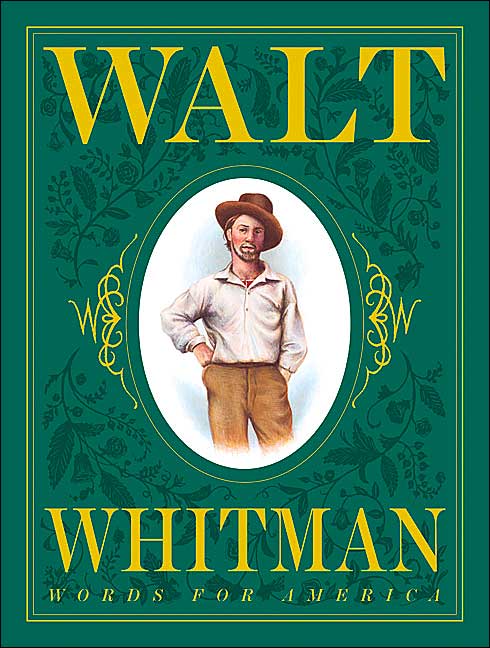
    WALT WHITMAN: WORDS FOR AMERICA


    Bibliographic Information:  Kerley, Barbara. Walt Whitman: Words For America. 2004. Ill. by Brian Selznick. New York, NY : Scholastic Press. ISBN 0-439-35791-8.

    Summary: 
    The book is a picture-book biography of one of America’s most famous and respected poets.  It focuses on his youth and his years of serving as a nurse to injured and dying Civil War soldiers.  Readers will see Whitman’s passion for words, his country and the ordinary people who populate it. 

    Critical Analysis:
    Author Barbara Kerley is a Sibert Informational Book Medal winner for her 2009 book “What to Do About Alice?:  How Alice Roosevelt Broke the Rules, Charmed the World, and Drove Her Father Teddy Crazy!”  She has written several informational books for children and is recognized as a reputable author in her field.  Walt Whitman: Words for America is a very interesting biography that is presented as lively and fun, with many beautiful illustrations by Brian Selznick – himself a Caldecott Medal winning illustrator and an author. 

    From the book’s cover – which features an iconic image of Whitman in a cut-out style portrait – through the last page, we see a logical, clear sequence of lovingly detailed illustrations of Whitman’s life.  First, he is a young typesetter, later a volunteer nurse with Civil War soldiers and on battlefields and finally we see Whitman struggling with President Lincoln’s assassination as the rest of the country was.

    The narrative of Whitman’s life is simple and straightforward and the author doesn’t overwhelm readers with facts in the body of the book.  Following the story, however, we are provided with extensive notes on Whitman, Lincoln and the era of (and after) the Civil War.  Selznick also includes a long note and then we see several of Whitman’s poems with notes.  A long list of sources and quotes used is further included.

    The book is a wonderful introduction to Whitman.  We see him in all his humanity and are introduced to the best of his works.  Beautiful illustrations complement the narrative and the easy flow of the story makes it read like fiction in that it’s fun and entertaining.  Should readers wish to know more about Whitman, Lincoln and/or the Civil War, the extensive notes and resources listed will send them onward well-prepared to do just that.

    Book Review Excerpts:
    “Delightfully old-fashioned in design, its oversized pages are replete with graceful illustrations and snippets of poetry. The brilliantly inventive paintings add vibrant testimonial to the nuanced text.” - Marilyn Taniguchi, Beverly Hills Public Library, CA -- Reviewed November 1, 2004 in School Library Journal (vol 50, issue 11, p166)

    “Selznick's versatile illustrations encompass a stark realism…and surreal whimsy…Copious quotes from his poems and correspondence let Whitman's eloquent voice resonate through the pages, and bountiful source notes remove any doubt of these talented collaborators' affection and admiration for their subject—their enthusiasm is convincing and contagious.” – Staff.  Reviewed October 18, 2004 in Publishers Weekly (vol. 251, issue 42, p64).

    “A cultural force rendered with power and immediacy for a new generation.” - Kirkus Reviews, September 15, 2004.

    Awards:
    ALA Notable Children's Books - Middle Readers Category: 2005
    New York Times Best Illustrated Children's Books: 2004
    Parents' Choice Awards - Nonfiction: 2004
    School Library Journal Best Books: 2004

    Connections/Further Activities:
    Follow up with more information on President Lincoln, the Civil War and Whitman’s own poetry.  Reading about these subjects or even screening excerpts from age-appropriate documentaries would help bring the experiences of Whitman’s life “home” to students.

    Title Read-A-Likes:
    Voice From Afar – Tony Johnston
    Emily Dickinson's Letters To The World – Jeanette Winter
    Carl Sandburg – Penelope Niven
    Coming home – Floyd Cooper

    Tuesday, February 26, 2013

    Jazz


    Bibliographic Information:
    Myers, Walter Dean. Jazz. 2006. Ill. by Christopher Myers. New York, NY : Holiday House. ISBN 0823415457.

    Summary:
    Jazz is a book of poetry explaining the origins of jazz music.   Poems and illustrations touch on be-bop and blues influences as well as the different unique instruments involved in playing jazz and some of the musical legends associated with the genre. 

    Critical Analysis:
    The book's introduction informs us  as to what jazz is - "an approach to music that is exciting and creative - one that relies on improvisation and spontaneity" and tells us of the many different styles of jazz including bebop, cool jazz, free jazz, fusion and swing. We're told that improvisation and rhythm are two crucial elements to this style of music and it's rich, embattled history is shared.  The history and importance of jazz in the lives of African-Americans is especially moving.

    The glossary of jazz terms and the jazz timeline included are very detailed and helpful, especially to readers who are not at all familiar with the different styles of jazz or it's rich history. We learn that in 1921, jazz was actually banned in Zion, Illinois and one of the many other jazz milestones mentioned, for instance, is in 1945 when Miles Davis left Juilliard to play with Charlie Parker.  What an historic moment!

    The vivid, popping illustrations of jazz men and women and their instruments make the lines nearly jump off the page at readers.  The soul in their faces and the tilts and lean of their bodies make us nearly able to hear the music they're playing. 

    The rhythm and rhyme of these poems beg for reading aloud.   The one titled Be-Bop says "Oh be-bop be-bop, oh whee, OH WHEEE!, don't you dig I'm free?" and later "And the melody I'm finding goes screa-min', goes screamin', goes screa-screa-screamin' to the moon!"  It just sounds like a jazz melody with all the exagerrated sounds. 

    The emotional imagery provided in selections such as "Session II" when Myers writes: "The drummer man is working, his rhythm got me on my knees.  I'm playing E-flat minor on my saxophone but I still know I got to go home all alone.  So have mercy, mercy, mercy, have mercy, Mr. Slide Trombone."  You can just imagine this sad sack of a man ready to cry in his drink over the loneliness that's tearing him apart.  It's not just honky-tonky music that makes men (and women) cry in their beer and demonstrating hat provides a sense of comraderie among all those of us, regardless of race, sex or age, who feel the same pain.  Music, specifically jazz as illustrated here, is a universal language we can all relate to.

    Book Review Excerpts:
    * Starred Review */ Gr 5-9 – "Expanding on Blues Journey (Holiday House, 2003), this talented father and son have produced new poetry and paintings to explore a wider repertoire of jazz forms. An introduction provides historical and technical background, briefly touching on influences, improvisation, rhythm, and race. Spreads then pulsate with the bold, acrylic-and-ink figures and distorted perspectives that interpret the multiple moods and styles set forth in the text." -  Wendy Lukehart, Washington DC Public Library --Wendy Lukehart (Reviewed September 1, 2006) (School Library Journal, vol 52, issue 9, p233).

    * Starred Review */ The father-and-son team behind blues journey creates a scintillating paean to jazz. Walter Dean Myers infuses his lines (and the rests between them) with so much savvy syncopation that readers can't help but be swept up in the rhythms...a cogent introduction, selective glossary and chronology round out this mesmerizing verbal and visual riff on a uniquely American art form. All ages." (Sept.) --Staff (Reviewed August 7, 2006) (Publishers Weekly, vol 253, issue 31, p57).

    "This offering stands as a welcome addition to the literature of jazz: In a genre all too often done poorly for children, it stands out as one of the few excellent treatments." (Picture book/poetry. 8+) (Kirkus Reviews, September 1, 2006).


    Awards:
    A Coretta Scott King Honor Book, Illustrator Category, 2007.


    Connections/Further Activities:
    I think it would be interesting to read this for a story time and then play some classic jazz songs to illustrate just what type of music jazz really is. 


    Title Read-A-Likes:
    Spirit seeker: John Coltrane's musical journey by Gary Golio
    Black cat bone by J. Patrick Lewis
    Dizzy by Jonah Winter
    Jazz Baby by Lisa Wheeler
    This Jazz Man by Karen Ehrhardt
    Jazzmatazz! by Stephanie Calmenson

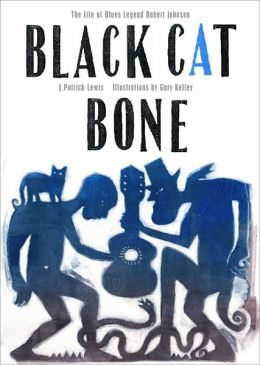
    Black Cat Bone

     
    .

    Bibliographic Information: 
    Lewis, J. Patrick. 2006. Black Cat Bone. Ill. by Gary Kelley. Mankato, MN: Creative Editions. ISBN: 978-1-56846-194-6.
     
    Summary:
    Black Cat Bone is a compilation of 19 poems about the famous blues musician, Robert Johnson, who lived from 1911-1938.  As Johnson is a man whose life has largely been shrouded in mystery and myth, it is sometimes difficult to tell fact from fiction.  Lewis has included all the known biographical details and made lots of mention of all the tall tales as well.  He gives us a well-rounded picture of just who Robert Johnson was while leaving some of the myth intact.  

    Critical Analysis:
    As a devoted fan of blues music and history, I couldn't help but adore this book.  The artwork is stark and sparse but so well suited to the poetry it's placed alongside.  My favorite poems are the ones that don't rhyme.  They don't feel forced into a formula.  They're just kind of a rambling tale of some small part of Johnson's life.  For instance, the first one - 1911 - had some of the best lines in the book.  "And on May 8th, in Hazelhurst, Mississippi, a misbegotten dot on a hardscrabble map, halfway between whatnot and nowhere, the clocks are wound to revolution.  A devil wind lifts the skirts of the South.  Robert Johnson is  born, and later baptized by the grace of the black gods of sound."  I literally got goosebumps from reading that!  Anyone familiar with the lore of Johnson's life and the honest-to-goodness historical legacy he left behind knows that, when he was born, things changed in the world of blues music.

    The Night Virginia Died ("Virginia might have made an honest man of Robert.  But his walking days began  the fateful evening death embraced his bride)" is another selection that gives us painful insight into what events truly made Johnson the blues man he was.  Jook Joint Saturday Night (with the original spelling of "juke") has such a tight rhythm and solid beat that you can just imagine it as the lyrics to a popular blues tune.  "Alive/hive, hum/drum, beat/street, fill/chill" - this one is tailor-made for reading aloud! 

    "What Son House Saw" provides so much accurate, historical background on Johnson.  It tells us where Son (and Willie Brown) were when Robert walked in (Banks, Mississippi) and that he had a Stella guitar.  Son told him to stick to playin' harp but Johnson insisted on playing guitar for the crowd.  "Here comes shame in a buggy," Son thought but Johson "goes to pickin' notes ungodly from a land unknown, singin' like a blackbird possessed."  I can just see, smell and hear everything that was going on as, for the first time ever, people heard and stood in awe of Johnson's guitar-playing prowess.  Let's face it.  If you can flabbergast Son House, you're doing some fine blues work.

    In between the poems are some of Johnson's own lyrics from songs like "Crossroads Blues," "Sweet Home Chicago," and "Terraplane Blues."  This gives readers unfamiliar with Johnson's work an idea of just how poetic his own lyrics were.  We see how his life and work progressed from birth, to first really showing talent, to writing his own songs, to unseating other blues royalty ("When you become the candle and he becomes the flame.  And you become late winter, and he becomes the spring.  And they pronounce you jester while they declare him king.")  We're told about his first recording session, his second wife whom he left, his affairs and drinking and, finally, his death at age 27 in 1938.

    The cover illustration and the ones accompanying the foreword and "Movin' On, Movin' Out Blues" are particularly enchanting.  You see the mysterious blues man, shrouded in darkness, with a black cat and a guitar, movin' on down the track.  They really bring the story home to readers, especially young ones with no former knowledge of Johnson and similar blues legends.

    The author, J. Patrick Lewis, tells the whole of Johnson's story while glossing over some of the gorier details.  Johnson was a hustler, a heavy drinker and womanizer who had no problem sleeping with other men's wives or leaving his own when her problems were bigger than he wanted to bear.  He has been famously rumored to have sold his very soul to Satan for the musical talent he came back to Mississippi with.  He is said to have been poisoned by the jealous husband of a woman he was running around with.  All this is mentioned but not dwelt upon.  As the intended audience is young and it's just a brief introduction to Johnson's life, that is certainly understandable and appreciated.  The foreword, endnotes and bibliography give lots of additional information for those seeking to learn more.

    Book Review Excerpts:
    "Kelley’s mixed-media illustrations in blues and browns add to the mood and enliven the layout. With further biographical and bibliographic notes at the end, the resulting package is surprisingly deep: what appears at first glance to be just an illustrated poetry collection is a well-supported narrative riff introducing Johnson–the man and his music. Though a picture book, this title requires at least a middle-school-age audience, and will be best appreciated by older young adults, finding resonance with musicians, poets, or other artists who are feeling the blues."  –Nina Lindsay, Oakland Public Library, CA --Nina Lindsay (Reviewed December 1, 2006) (School Library Journal, vol 52, issue 12, p165).

    "Kelley's beautiful brooding illustrations, multicolor monotypes using etching ink on plexiglass, add elegance to the mystique. A foreword and lengthy endnotes provide a more straightforward narrative of his life; a brief bibliography offers only adult resources. A stylish and artful work that will hold appeal for adults as well." (Picture book. 11+) (Kirkus Reviews, September 1, 2006)


    Awards:
    School Library Journal Best Books 2006

    Connections/Further Activities:
    Novelist has this title listed on a "Curricular Connection: Music for grades 3-5:"  http://web.ebscohost.com/novpk8/detail?vid=6&sid=df1d9100-8743-4104-ab54-82764037acae%40sessionmgr115&hid=118&bdata=JnNpdGU9bm92cGs4LWxpdmU%3d#db=njh&UI=433448
    I think pairing a reading of the book with some of Robert Johnson's actual music (perhaps the songs whose lyrics are included in the book) would make for a fun, educational story time.

    Title Read-A-Likes:
    "Dizzy" by Jonah Winter
    "Jazz" by Walter Dean Myers
    "Little Stevie Wonder" by Quincy Troupe
    "Honky-tonk Heroes and Hillbilly Angels" by Holly George-Warren


    Hidden


    Bibliographic information:
    Frost, Helen. Hidden.  2011.   New York, NY: Farrar Straus Giroux.  ISBN 0374382212.

    Summary:
    8 year old Wren is accidentally kidnapped when a man steals her mother's mini-van, unaware that she is inside.  Once the van is locked inside his home garage, the thief's own 8 year old daughter, Darra, discovers Wren there and sneaks her some food while she remains hidden for two days before escaping.  Six years later the girls, now both 14, meet again at summer camp.  Finally face-to--face with each other again, they end up realizing that, though they've blamed each other a lot over the years, neither of them is at fault.

    Critical Analysis:
    The narrative alternates back and forth between Wren and Darra, telling the story of each separately before they meet up and interact so many years after the event that shaped both of their lives.  We read of the events at the convenience store (the shot fired, a man stealing the van with Wren inside) and Wren's subsequent (inadvertant) captivity and escape.  All of this is from her perspective.  Once she is free and Darra's father is arrested, the story is told from Darra's point of view.

    The emotional impact of this novel in verse is hard-hitting.  How each of the girls feels during and after the events is really poured out to us as readers.  On thinking back to what happened, Wren says "I think about that little girl the way you might remember your best friend who moved away."  The emotional distance she has had to put between herself and the kidnapping is what has helped her cope.  At one point Wren also says: "I have to find a way to tell her (Darra) I don't want to talk about what happened without it sounding like I'm still messed up about it.  Because I'm not.  I got over all that long ago.  Really.  I'm fine."  Sounds like she doth protest too much because she still is very much affected by it and Darra's presence.

    Darra, on the other hand, initially seeks to blame everyone but her father for what happened.  See says that if Wren "hadn't led the cops to our house that morning, Dad would probably still be home with us" and they could be heading out to the lake again as a family.  She even blames her dog, Bilbo, saying "What kind of dog betrays its own family?" because he had found Wren's missing shoe that was used as evidence that she'd been at Darra's house. 

    The connection that the girls eventually make at camp is healing for both of them.  At first, Darra panics and wants to leave but decides that, if she does, she'll "never get to know her - the girl from back then, those two days on TV, trapped in our garage.  But more: who she is now."   It's very moving when we read how Darra insists that her father is not a monster and how she loved him as much as anyone else ever loved their father in spite of the yelling and hitting.  Wren says she often wondered if it was better for Darra and her mother after West was incarcerated and that she told herself what she "had to believe.  Yes. They were.  Now Darra is telling me I'm wrong."

    The girls come to see the situation from each other's point of view and develop true empathy for one another.  The fact that the narrative ends with them being friends demonstrates a powerful message of love and forgiveness to readers. 

    This novel in verse is very much unlike what we typically think of as poetry.  It doesn't rhyme and doesn't have a special beat or rhythm to the words.  Matching sounds and unusual sound effects are not part of this book.  It's a narrative in verse form.  It tells the story without ever really seeming like it's poetry and the words are so powerful and have so much impact that the reader can't help but be affected during and long after reading them.

    Book review excerpts:
    "This original blend of crime tale, psychological study, and friendship story is a page-turner that kids will love. There are a few plausibility issues, but there are many more strengths. Wren's captivity in the garage is truly suspenseful, and the various interactions of the kids at the sleepover camp are a study in shifting alliances. The book also touches on some deeper issues, like how you can love a parent who is sometimes abusive, and how sensitive kids can blame themselves for things that aren't really their fault. Smoothly written, this novel carries a message of healing and hope." —Lauralyn Persson, Wilmette Public Library, IL --Lauralyn Persson (Reviewed June 1, 2011) (School Library Journal, vol 57, issue 6, p116).

    "...Frost's lyric narrative resolves movingly by alternating between the two protagonists. Frost's tale exhibits her trademark character development that probes the complexities of intimate relationships. Here Wren's touching statement, 'I was a happy little girl / wearing a pink dress,' eventually leads to Darra's private admission to Wren: 'None of it was our fault.' Both tender and insightful, this well-crafted, fast-paced tale should have wide teen appeal." (Poetry. 10-16)(Kirkus Reviews, April 1, 2011).

    Awards:
    ALA Notable Children's Books - Older Reader's Category: 2012
  • Connections/Further activities:After reading aloud selected passages from the book, ask participants to think of someone they feel has "wronged" them and then to think about what it might be like to have to face them and understand the situation from their perspective.  If anyone volunteers to speak about their particular scenario, it could open up a powerful discussion about understanding and forgiveness.

    Title Read-a-Likes:
    Crank, Impulse and Tilt by Eileen Hopkins
    What My Mother Doesn't Know and What My Girlfriend Doesn't Know by Sonya Sones
    Because I Am Furniture by Thalia Chaltas
    The Brimstone Journals by Ronald Koertge