
.
Bibliographic
Information:
Lewis,
J. Patrick. 2006. Black Cat Bone.
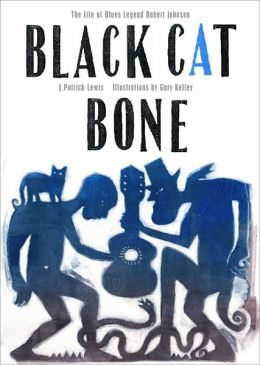
Ill. by Gary Kelley. Mankato, MN: Creative Editions. ISBN: 978-1-56846-194-6.Black Cat Bone is a compilation of 19 poems about the famous blues musician, Robert Johnson, who lived from 1911-1938. As Johnson is a man whose life has largely been shrouded in mystery and myth, it is sometimes difficult to tell fact from fiction. Lewis has included all the known biographical details and made lots of mention of all the tall tales as well. He gives us a well-rounded picture of just who Robert Johnson was while leaving some of the myth intact.
Critical Analysis:
As a devoted fan of blues music and history, I couldn't help but adore this book. The artwork is stark and sparse but so well suited to the poetry it's placed alongside. My favorite poems are the ones that don't rhyme. They don't feel forced into a formula. They're just kind of a rambling tale of some small part of Johnson's life. For instance, the first one - 1911 - had some of the best lines in the book. "And on May 8th, in Hazelhurst, Mississippi, a misbegotten dot on a hardscrabble map, halfway between whatnot and nowhere, the clocks are wound to revolution. A devil wind lifts the skirts of the South. Robert Johnson is born, and later baptized by the grace of the black gods of sound." I literally got goosebumps from reading that! Anyone familiar with the lore of Johnson's life and the honest-to-goodness historical legacy he left behind knows that, when he was born, things changed in the world of blues music.
The Night Virginia Died ("Virginia might have made an honest man of Robert. But his walking days began the fateful evening death embraced his bride)" is another selection that gives us painful insight into what events truly made Johnson the blues man he was. Jook Joint Saturday Night (with the original spelling of "juke") has such a tight rhythm and solid beat that you can just imagine it as the lyrics to a popular blues tune. "Alive/hive, hum/drum, beat/street, fill/chill" - this one is tailor-made for reading aloud!
"What Son House Saw" provides so much accurate, historical background on Johnson. It tells us where Son (and Willie Brown) were when Robert walked in (Banks, Mississippi) and that he had a Stella guitar. Son told him to stick to playin' harp but Johnson insisted on playing guitar for the crowd. "Here comes shame in a buggy," Son thought but Johson "goes to pickin' notes ungodly from a land unknown, singin' like a blackbird possessed." I can just see, smell and hear everything that was going on as, for the first time ever, people heard and stood in awe of Johnson's guitar-playing prowess. Let's face it. If you can flabbergast Son House, you're doing some fine blues work.
In between the poems are some of Johnson's own lyrics from songs like "Crossroads Blues," "Sweet Home Chicago," and "Terraplane Blues." This gives readers unfamiliar with Johnson's work an idea of just how poetic his own lyrics were. We see how his life and work progressed from birth, to first really showing talent, to writing his own songs, to unseating other blues royalty ("When you become the candle and he becomes the flame. And you become late winter, and he becomes the spring. And they pronounce you jester while they declare him king.") We're told about his first recording session, his second wife whom he left, his affairs and drinking and, finally, his death at age 27 in 1938.
The cover illustration and the ones accompanying the foreword and "Movin' On, Movin' Out Blues" are particularly enchanting. You see the mysterious blues man, shrouded in darkness, with a black cat and a guitar, movin' on down the track. They really bring the story home to readers, especially young ones with no former knowledge of Johnson and similar blues legends.
The author, J. Patrick Lewis, tells the whole of Johnson's story while glossing over some of the gorier details. Johnson was a hustler, a heavy drinker and womanizer who had no problem sleeping with other men's wives or leaving his own when her problems were bigger than he wanted to bear. He has been famously rumored to have sold his very soul to Satan for the musical talent he came back to Mississippi with. He is said to have been poisoned by the jealous husband of a woman he was running around with. All this is mentioned but not dwelt upon. As the intended audience is young and it's just a brief introduction to Johnson's life, that is certainly understandable and appreciated. The foreword, endnotes and bibliography give lots of additional information for those seeking to learn more.
Book Review Excerpts:
"Kelley’s mixed-media illustrations in blues and browns add to the mood and enliven the layout. With further biographical and bibliographic notes at the end, the resulting package is surprisingly deep: what appears at first glance to be just an illustrated poetry collection is a well-supported narrative riff introducing Johnson–the man and his music. Though a picture book, this title requires at least a middle-school-age audience, and will be best appreciated by older young adults, finding resonance with musicians, poets, or other artists who are feeling the blues." –Nina Lindsay, Oakland Public Library, CA --Nina Lindsay (Reviewed December 1, 2006) (School Library Journal, vol 52, issue 12, p165).
"Kelley's beautiful brooding illustrations, multicolor monotypes using etching ink on plexiglass, add elegance to the mystique. A foreword and lengthy endnotes provide a more straightforward narrative of his life; a brief bibliography offers only adult resources. A stylish and artful work that will hold appeal for adults as well." (Picture book. 11+) (Kirkus Reviews, September 1, 2006)
Awards:
School Library Journal Best Books 2006
Connections/Further Activities:
Novelist has this title listed on a "Curricular Connection: Music for grades 3-5:" http://web.ebscohost.com/novpk8/detail?vid=6&sid=df1d9100-8743-4104-ab54-82764037acae%40sessionmgr115&hid=118&bdata=JnNpdGU9bm92cGs4LWxpdmU%3d#db=njh&UI=433448
I think pairing a reading of the book with some of Robert Johnson's actual music (perhaps the songs whose lyrics are included in the book) would make for a fun, educational story time.
Title Read-A-Likes:
"Dizzy" by Jonah Winter
"Jazz" by Walter Dean Myers
"Little Stevie Wonder" by Quincy Troupe
"Honky-tonk Heroes and Hillbilly Angels" by Holly George-Warren

No comments:
Post a Comment