Tuesday, February 26, 2013

Jazz


Bibliographic Information:
Myers, Walter Dean. Jazz. 2006. Ill. by Christopher Myers. New York, NY : Holiday House. ISBN 0823415457.

Summary:
Jazz is a book of poetry explaining the origins of jazz music.   Poems and illustrations touch on be-bop and blues influences as well as the different unique instruments involved in playing jazz and some of the musical legends associated with the genre. 

Critical Analysis:
The book's introduction informs us  as to what jazz is - "an approach to music that is exciting and creative - one that relies on improvisation and spontaneity" and tells us of the many different styles of jazz including bebop, cool jazz, free jazz, fusion and swing. We're told that improvisation and rhythm are two crucial elements to this style of music and it's rich, embattled history is shared.  The history and importance of jazz in the lives of African-Americans is especially moving.

The glossary of jazz terms and the jazz timeline included are very detailed and helpful, especially to readers who are not at all familiar with the different styles of jazz or it's rich history. We learn that in 1921, jazz was actually banned in Zion, Illinois and one of the many other jazz milestones mentioned, for instance, is in 1945 when Miles Davis left Juilliard to play with Charlie Parker.  What an historic moment!

The vivid, popping illustrations of jazz men and women and their instruments make the lines nearly jump off the page at readers.  The soul in their faces and the tilts and lean of their bodies make us nearly able to hear the music they're playing. 

The rhythm and rhyme of these poems beg for reading aloud.   The one titled Be-Bop says "Oh be-bop be-bop, oh whee, OH WHEEE!, don't you dig I'm free?" and later "And the melody I'm finding goes screa-min', goes screamin', goes screa-screa-screamin' to the moon!"  It just sounds like a jazz melody with all the exagerrated sounds. 

The emotional imagery provided in selections such as "Session II" when Myers writes: "The drummer man is working, his rhythm got me on my knees.  I'm playing E-flat minor on my saxophone but I still know I got to go home all alone.  So have mercy, mercy, mercy, have mercy, Mr. Slide Trombone."  You can just imagine this sad sack of a man ready to cry in his drink over the loneliness that's tearing him apart.  It's not just honky-tonky music that makes men (and women) cry in their beer and demonstrating hat provides a sense of comraderie among all those of us, regardless of race, sex or age, who feel the same pain.  Music, specifically jazz as illustrated here, is a universal language we can all relate to.

Book Review Excerpts:
* Starred Review */ Gr 5-9 – "Expanding on Blues Journey (Holiday House, 2003), this talented father and son have produced new poetry and paintings to explore a wider repertoire of jazz forms. An introduction provides historical and technical background, briefly touching on influences, improvisation, rhythm, and race. Spreads then pulsate with the bold, acrylic-and-ink figures and distorted perspectives that interpret the multiple moods and styles set forth in the text." -  Wendy Lukehart, Washington DC Public Library --Wendy Lukehart (Reviewed September 1, 2006) (School Library Journal, vol 52, issue 9, p233).

* Starred Review */ The father-and-son team behind blues journey creates a scintillating paean to jazz. Walter Dean Myers infuses his lines (and the rests between them) with so much savvy syncopation that readers can't help but be swept up in the rhythms...a cogent introduction, selective glossary and chronology round out this mesmerizing verbal and visual riff on a uniquely American art form. All ages." (Sept.) --Staff (Reviewed August 7, 2006) (Publishers Weekly, vol 253, issue 31, p57).

"This offering stands as a welcome addition to the literature of jazz: In a genre all too often done poorly for children, it stands out as one of the few excellent treatments." (Picture book/poetry. 8+) (Kirkus Reviews, September 1, 2006).


Awards:
A Coretta Scott King Honor Book, Illustrator Category, 2007.


Connections/Further Activities:
I think it would be interesting to read this for a story time and then play some classic jazz songs to illustrate just what type of music jazz really is. 


Title Read-A-Likes:
Spirit seeker: John Coltrane's musical journey by Gary Golio
Black cat bone by J. Patrick Lewis
Dizzy by Jonah Winter
Jazz Baby by Lisa Wheeler
This Jazz Man by Karen Ehrhardt
Jazzmatazz! by Stephanie Calmenson

Black Cat Bone

 
.

Bibliographic Information: 
Lewis, J. Patrick. 2006. Black Cat Bone. Ill. by Gary Kelley. Mankato, MN: Creative Editions. ISBN: 978-1-56846-194-6.
 
Summary:
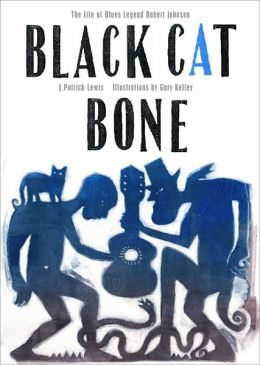
Black Cat Bone is a compilation of 19 poems about the famous blues musician, Robert Johnson, who lived from 1911-1938.  As Johnson is a man whose life has largely been shrouded in mystery and myth, it is sometimes difficult to tell fact from fiction.  Lewis has included all the known biographical details and made lots of mention of all the tall tales as well.  He gives us a well-rounded picture of just who Robert Johnson was while leaving some of the myth intact.  

Critical Analysis:
As a devoted fan of blues music and history, I couldn't help but adore this book.  The artwork is stark and sparse but so well suited to the poetry it's placed alongside.  My favorite poems are the ones that don't rhyme.  They don't feel forced into a formula.  They're just kind of a rambling tale of some small part of Johnson's life.  For instance, the first one - 1911 - had some of the best lines in the book.  "And on May 8th, in Hazelhurst, Mississippi, a misbegotten dot on a hardscrabble map, halfway between whatnot and nowhere, the clocks are wound to revolution.  A devil wind lifts the skirts of the South.  Robert Johnson is  born, and later baptized by the grace of the black gods of sound."  I literally got goosebumps from reading that!  Anyone familiar with the lore of Johnson's life and the honest-to-goodness historical legacy he left behind knows that, when he was born, things changed in the world of blues music.

The Night Virginia Died ("Virginia might have made an honest man of Robert.  But his walking days began  the fateful evening death embraced his bride)" is another selection that gives us painful insight into what events truly made Johnson the blues man he was.  Jook Joint Saturday Night (with the original spelling of "juke") has such a tight rhythm and solid beat that you can just imagine it as the lyrics to a popular blues tune.  "Alive/hive, hum/drum, beat/street, fill/chill" - this one is tailor-made for reading aloud! 

"What Son House Saw" provides so much accurate, historical background on Johnson.  It tells us where Son (and Willie Brown) were when Robert walked in (Banks, Mississippi) and that he had a Stella guitar.  Son told him to stick to playin' harp but Johnson insisted on playing guitar for the crowd.  "Here comes shame in a buggy," Son thought but Johson "goes to pickin' notes ungodly from a land unknown, singin' like a blackbird possessed."  I can just see, smell and hear everything that was going on as, for the first time ever, people heard and stood in awe of Johnson's guitar-playing prowess.  Let's face it.  If you can flabbergast Son House, you're doing some fine blues work.

In between the poems are some of Johnson's own lyrics from songs like "Crossroads Blues," "Sweet Home Chicago," and "Terraplane Blues."  This gives readers unfamiliar with Johnson's work an idea of just how poetic his own lyrics were.  We see how his life and work progressed from birth, to first really showing talent, to writing his own songs, to unseating other blues royalty ("When you become the candle and he becomes the flame.  And you become late winter, and he becomes the spring.  And they pronounce you jester while they declare him king.")  We're told about his first recording session, his second wife whom he left, his affairs and drinking and, finally, his death at age 27 in 1938.

The cover illustration and the ones accompanying the foreword and "Movin' On, Movin' Out Blues" are particularly enchanting.  You see the mysterious blues man, shrouded in darkness, with a black cat and a guitar, movin' on down the track.  They really bring the story home to readers, especially young ones with no former knowledge of Johnson and similar blues legends.

The author, J. Patrick Lewis, tells the whole of Johnson's story while glossing over some of the gorier details.  Johnson was a hustler, a heavy drinker and womanizer who had no problem sleeping with other men's wives or leaving his own when her problems were bigger than he wanted to bear.  He has been famously rumored to have sold his very soul to Satan for the musical talent he came back to Mississippi with.  He is said to have been poisoned by the jealous husband of a woman he was running around with.  All this is mentioned but not dwelt upon.  As the intended audience is young and it's just a brief introduction to Johnson's life, that is certainly understandable and appreciated.  The foreword, endnotes and bibliography give lots of additional information for those seeking to learn more.

Book Review Excerpts:
"Kelley’s mixed-media illustrations in blues and browns add to the mood and enliven the layout. With further biographical and bibliographic notes at the end, the resulting package is surprisingly deep: what appears at first glance to be just an illustrated poetry collection is a well-supported narrative riff introducing Johnson–the man and his music. Though a picture book, this title requires at least a middle-school-age audience, and will be best appreciated by older young adults, finding resonance with musicians, poets, or other artists who are feeling the blues."  –Nina Lindsay, Oakland Public Library, CA --Nina Lindsay (Reviewed December 1, 2006) (School Library Journal, vol 52, issue 12, p165).

"Kelley's beautiful brooding illustrations, multicolor monotypes using etching ink on plexiglass, add elegance to the mystique. A foreword and lengthy endnotes provide a more straightforward narrative of his life; a brief bibliography offers only adult resources. A stylish and artful work that will hold appeal for adults as well." (Picture book. 11+) (Kirkus Reviews, September 1, 2006)


Awards:
School Library Journal Best Books 2006

Connections/Further Activities:
Novelist has this title listed on a "Curricular Connection: Music for grades 3-5:"  http://web.ebscohost.com/novpk8/detail?vid=6&sid=df1d9100-8743-4104-ab54-82764037acae%40sessionmgr115&hid=118&bdata=JnNpdGU9bm92cGs4LWxpdmU%3d#db=njh&UI=433448
I think pairing a reading of the book with some of Robert Johnson's actual music (perhaps the songs whose lyrics are included in the book) would make for a fun, educational story time.

Title Read-A-Likes:
"Dizzy" by Jonah Winter
"Jazz" by Walter Dean Myers
"Little Stevie Wonder" by Quincy Troupe
"Honky-tonk Heroes and Hillbilly Angels" by Holly George-Warren


Hidden


Bibliographic information:
Frost, Helen. Hidden.  2011.   New York, NY: Farrar Straus Giroux.  ISBN 0374382212.

Summary:
8 year old Wren is accidentally kidnapped when a man steals her mother's mini-van, unaware that she is inside.  Once the van is locked inside his home garage, the thief's own 8 year old daughter, Darra, discovers Wren there and sneaks her some food while she remains hidden for two days before escaping.  Six years later the girls, now both 14, meet again at summer camp.  Finally face-to--face with each other again, they end up realizing that, though they've blamed each other a lot over the years, neither of them is at fault.

Critical Analysis:
The narrative alternates back and forth between Wren and Darra, telling the story of each separately before they meet up and interact so many years after the event that shaped both of their lives.  We read of the events at the convenience store (the shot fired, a man stealing the van with Wren inside) and Wren's subsequent (inadvertant) captivity and escape.  All of this is from her perspective.  Once she is free and Darra's father is arrested, the story is told from Darra's point of view.

The emotional impact of this novel in verse is hard-hitting.  How each of the girls feels during and after the events is really poured out to us as readers.  On thinking back to what happened, Wren says "I think about that little girl the way you might remember your best friend who moved away."  The emotional distance she has had to put between herself and the kidnapping is what has helped her cope.  At one point Wren also says: "I have to find a way to tell her (Darra) I don't want to talk about what happened without it sounding like I'm still messed up about it.  Because I'm not.  I got over all that long ago.  Really.  I'm fine."  Sounds like she doth protest too much because she still is very much affected by it and Darra's presence.

Darra, on the other hand, initially seeks to blame everyone but her father for what happened.  See says that if Wren "hadn't led the cops to our house that morning, Dad would probably still be home with us" and they could be heading out to the lake again as a family.  She even blames her dog, Bilbo, saying "What kind of dog betrays its own family?" because he had found Wren's missing shoe that was used as evidence that she'd been at Darra's house. 

The connection that the girls eventually make at camp is healing for both of them.  At first, Darra panics and wants to leave but decides that, if she does, she'll "never get to know her - the girl from back then, those two days on TV, trapped in our garage.  But more: who she is now."   It's very moving when we read how Darra insists that her father is not a monster and how she loved him as much as anyone else ever loved their father in spite of the yelling and hitting.  Wren says she often wondered if it was better for Darra and her mother after West was incarcerated and that she told herself what she "had to believe.  Yes. They were.  Now Darra is telling me I'm wrong."

The girls come to see the situation from each other's point of view and develop true empathy for one another.  The fact that the narrative ends with them being friends demonstrates a powerful message of love and forgiveness to readers. 

This novel in verse is very much unlike what we typically think of as poetry.  It doesn't rhyme and doesn't have a special beat or rhythm to the words.  Matching sounds and unusual sound effects are not part of this book.  It's a narrative in verse form.  It tells the story without ever really seeming like it's poetry and the words are so powerful and have so much impact that the reader can't help but be affected during and long after reading them.

Book review excerpts:
"This original blend of crime tale, psychological study, and friendship story is a page-turner that kids will love. There are a few plausibility issues, but there are many more strengths. Wren's captivity in the garage is truly suspenseful, and the various interactions of the kids at the sleepover camp are a study in shifting alliances. The book also touches on some deeper issues, like how you can love a parent who is sometimes abusive, and how sensitive kids can blame themselves for things that aren't really their fault. Smoothly written, this novel carries a message of healing and hope." —Lauralyn Persson, Wilmette Public Library, IL --Lauralyn Persson (Reviewed June 1, 2011) (School Library Journal, vol 57, issue 6, p116).

"...Frost's lyric narrative resolves movingly by alternating between the two protagonists. Frost's tale exhibits her trademark character development that probes the complexities of intimate relationships. Here Wren's touching statement, 'I was a happy little girl / wearing a pink dress,' eventually leads to Darra's private admission to Wren: 'None of it was our fault.' Both tender and insightful, this well-crafted, fast-paced tale should have wide teen appeal." (Poetry. 10-16)(Kirkus Reviews, April 1, 2011).

Awards:
ALA Notable Children's Books - Older Reader's Category: 2012
  • Connections/Further activities:After reading aloud selected passages from the book, ask participants to think of someone they feel has "wronged" them and then to think about what it might be like to have to face them and understand the situation from their perspective.  If anyone volunteers to speak about their particular scenario, it could open up a powerful discussion about understanding and forgiveness.

    Title Read-a-Likes:
    Crank, Impulse and Tilt by Eileen Hopkins
    What My Mother Doesn't Know and What My Girlfriend Doesn't Know by Sonya Sones
    Because I Am Furniture by Thalia Chaltas
    The Brimstone Journals by Ronald Koertge

    Monday, February 11, 2013

    RAPUNZEL


    Bibliographic Information:
    Zelinsky, Paul O.  1997. Rapunzel.  Ill. by Paul O. Zelinsky.  New York, NY: Puffin Books.  ISBN 978-0-7569-1310-6.
     
    Summary:
    A couple expecting a child lives next to the garden of a sorceress.  When the expectant mother begins to crave some of the herb (rapunzel) that she sees growing there, the husband goes to take some and is caught by the sorceress.  He is allowed to take the herb to his sickly wife only if he vows that the sorceress can have the child when it is born.  When this happens, she appears, names the child Rapunzel and takes her away to eventually live alone in an isolated tower in the forest.
     
    Years later when a king’s son is riding through and hears Rapunzel singing, he climbs up into the tower via her flowing her as he’d observed the sorceress doing.  They fall in love, marry in a private ceremony and are expecting a child when the sorceress discovers their secret relationship.  What will become of Rapunzel, her prince and baby now?
     
     
    Critical Analysis:
    The usual good-vs-evil theme is a little toned down in this retelling of Rapunzel.  The sorceress is not some wicked, hag-like crone but rather seemingly (at times) a kind, caring person.  She does take Rapunzel from her parents but the narrative tells us she “cared for the baby, seeing to her every need.”  Only when she reached the age of twelve, does she lock her up in the tower.  Later in the story, she confronts Rapunzel when she finds out she is expecting a child and says “I thought I had kept you safe, away from the whole world, but you have betrayed me.”  She feared the effects living among others in society would have on Rapunzel and attempted to keep her totally away from it all.  But is that really “protection” or is it abusive and unfair?  And is her over-protective behavior and subsequent anger and bewilderment when it didn’t work really any different from that of many parents who attempt to “protect” their child from the world at all costs? 
     
    This is another great example of how a touchy question can be addressed without overly sermonizing about it.  The narrative can subtly prompt parents and children to discuss the sorceress’s behavior and motives and how modern parents can avoid the same errors.  Obviously, they’re not going to lock their children in towers in the forests but not allowing them any freedom or privacy is the modern equivalent of that, is it not?  Trying to “protect” them by controlling every aspect of their lives is no less misguided than the sorceress’s attempts to kepp Rapunzel from the influences of the world at large.
     
    The illustrations in this book are absolutely beautiful.  They look like recreations of fine Renaissance art.  According to the extensive notes in the book, Zelinsky used oil painting to evoke the feeling of Italy during that period of time.  The loving expressions on the faces of all the characters, including the sorceress when she is watching Rapunzel play as a young child, really sets the tone and demonstrates the love among the various characters.  Similarly, the looks on their faces at time of trouble are realistically portrayed as disturbed.  The interior of the houses and the exterior shots of the garden, the forest and the tower are all very detailed and alluring.  Who wouldn’t want to live there?  Even the tower is beautiful inside and out.  The accuracy in detail of the wardrobes is very interesting and the recurring appearances of cat’s in the images is another fine detail Zelinsky was sure to include.  Not only are the illustrations exquisite but they are detailed and historically accurate.  It’s a fascinating combination.
     
     
    Book Review Excerpts:
    “Exquisite paintings in late Italian Renaissance style illumine this hybrid version of a classic tale. As Zelinsky (The Wheels on the Bus, 1990, etc.) explains in a long source note, the story's Italian oral progenitor went through a series of literary revisions and translations before the Brothers Grimm published their own take; he draws on many of these to create a formal, spare text that is more about the undercurrents between characters than crime and punishment…Zelinsky's landscapes and indoor scenes are grandly evocative, composed and executed with superb technical and emotional command.”  (Kirkus Reviews, September 15, 1997)
     
    “The rich oil paintings evoke the portraits, sculpture, architecture, and light-filled landscapes of Renaissance art. The costumes are lavish, the interiors intricate. Rapunzel is both gorgeous and maidenly. The sorceress is terrifying: the pictures also reveal her motherliness and her vulnerability, especially in the two double-page narrative paintings that frame the drama. One shows the sorceress taking the baby--and we see how she lovingly cradles it in her arms; in the climactic painting, when Rapunzel, the prince, and their children find each other, the whole natural world of rock and sky and tree seem to close around them in a loving embrace. Children--and adults--will pore over the intricate detail and glowing colors; they will also be moved by the mysterious tale of nurture and passion and terror.”  (Reviewed November 15, 1997) Copyright 2000 Booklist Reviews.
     
    “It takes a scholar's mind and an artist's insight to endow the familiar with unexpected nuances--which Zelinsky does with passion and dazzling technique. His choice of a Renaissance setting is inspired, allowing for many artistic and architectural allusions. The book demonstrates respect for the traditions of painting and the fairy tale while at the same time adhering to a singular, wholly original, artistic vision. Extensive notes are appended.” Copyright 1998 Horn Book Guide Reviews
     
     
    Awards:
    Winner of the Caldecott Medal, 1998.
     
     
    Connections/Further Activities:
    Bring some of the actual herb, rapunzel, in for children to see, touch and taste.  It's also known as "rampion:"  http://en.wikipedia.org/wiki/Campanula_rapunculus
     
    Do a craft project by using cardboard tubes from paper towel rolls to form a tall tower that children can make a window in and decorate.  This could be done as one huge one they all work on together or each could do an individual one of less height.
     
     
    Title read-a-likes:
    The love for three oranges - by Sergei Prokofiev; illustrated by Elzbieta Gaudasinska.
     
    Hansel and Gretel – retold by Rika Lesser; illustrated by Paul O. Zelinsky.
     
    Rumpelstiltskin – retold and illustrated by Paul O. Zelinsky.

    THE TRUE STORY OF THE 3 LITTLE PIGS!


    Bibliographic Information:
    Scieszka, Jon.  1989. The True Story of the 3 Little Pigs!  Ill. by Lane Smith. New York, NY: Puffin Books.  ISBN 0-670-82759-2.

    Summary:
    Purportedly told by A. Wolf, this is the supposed true story of what really happened between the three little pigs and the really not so “big bad” wolf.  Involving a giant sneeze attack and the need to simply borrow a cup of sugar from his neighbors, it’s quite the tall tale.  The pigs were killed by accident and only eaten because it would be a shame to waste them and the wolf was only trying to break the third pig’s door down because he’d been rude about the wolf’s grandma.  None of that would make a very exciting story, admittedly, so the reporters spiced it up, put a slant on it and framed the innocent wolf, he says.

    Critical Analysis:
    This is a very funny story that attempts to show the other side of this famous tale.  Told from the point of view of Alexander T. Wolf (Al, for short), it attempts to explain away the seemingly violent and predatory actions of the wolf.  He can’t help that he’s a carnivore and he sure doesn’t want to be wasteful.  The story really attempts to show the reality of being a carnivorous wolf as he repeatedly compares the pigs to a meal like a “big cheeseburger” that most of us humans couldn’t pass up and wouldn’t want to waste either.  Much like a good human too, he only wants to bake his dear sweet grandmother a cake and can’t because he’s out of sugar.  He can’t help it that he sneezes and blows down the houses made of hay and sticks that he visits.  Who would make a house out of such silly, easily destroyed materials anyway, he thinks.  He wears spectacles and even uses a handkerchief.  He’s just like us, right?

    Though he offers up very logical sounding defenses and arguments, as a reader, I just couldn’t buy it.  I think young readers will be able to understand where he’s coming from but still not be swayed by his pleas of innocence. 

    The narrative stays very close to the original “three little pigs and the big, bad wolf” tales most of us have grown up hearing and reading.  There’s a wolf, three pig brothers, three houses made of hay, sticks and brick and sneezing which causes the first two houses to fall down and kill the pigs.  Only the third pig in the house of brick survives in each tale. 

    The illustrations do much to complement the story as they are just as humorous.  We see drawings of a giant cheeseburger to illustrate just how hard to resist it would be to us humans.  We see the wolf baking a cake for his granny in a kitchen where her picture hangs behind him and the mixing bowl contains whole eggs with shells and a rabbit whose ears are sticking out of the bowl.  Drawings of pigs’ bottoms complete with curly-cue tails sticking up out of the rubble of fallen houses are sure to get laughs.  The final laugh comes from him asking if the reader can loan him a “cup of sugar” as he hands us a metal cup with “Pig Penn” written on it as the name of the prison in which he’s incarcerated. 

    This book is one of several that attempt to tell the “real” stories behind the tales we’ve heard.  It’s funny and engaging and very popular with readers young and older alike.  It’s an excellent story time choice as laughs are guaranteed and the concept of knowing there’s another “side” to a story and hearing it, even if it’s not totally believable, is a good one to share with young readers.

    Book Review Excerpts:
    “Smith's highly imaginative watercolors eschew realism, further updating the tale, though some may find their urbane stylization and intentionally static quality mystifyingly adult. Designed with uncommon flair, this alternative fable is both fetching and glib.”  (Sept.) Copyright 1989 Cahners Business Information.

    “Smith's dark tones and sometimes shadowy, indistinct shapes recall the distinctive illustrations he did for Merriam's Halloween ABC (Macmillan, 1987); the bespectacled wolf moves with a rather sinister bonelessness, and his juicy sneezes tear like thunderbolts through a dim, grainy world. It's the type of book that older kids (and adults) will find very funny.”  --John Peters, New York Public Library Copyright 1989 Cahners Business Information.

    Connections/Further Activities:
    A story time program could involve discussing other tales attendees have heard or read and what the “true story” of those might really be (i.e. – Cinderella, Three Billy Goats Gruff, Jack and the Beanstalk, etc).  They could probably think of believable explanations for the behavior of the “villains” in those tales as well as others. 

    After seeing what they think of on their own, share some read-a-like titles such as the ones listed below to see if any thought of similar ones and to inspire them to read more stories along the same line if they liked this one. 

    Title read-a-likes:
    The Stinky Cheese Man and other fairly stupid tales - Jon Scieszka & Lane Smith

    Terrible tales: the absolutely, positively, 100 percent true stories of Cinderella, Little Red Riding Hood, those three greedy pigs, Hairy Rapunzel, and the utterly horrible brats, Hansel and Gretel as told at the beginning of time – Jennifer Gordon

    The three bully goats – Leslie Kimmelman

    Sleeping Ugly – Jane Yolen

    THE FIRST STRAWBERRIES: A CHEROKEE STORY


    Bibliographic Information:
    Bruchac, Joseph.  1993. The First Strawberries: A Cherokee Story.  Ill. by Anna Vojtech. New York, NY: Dial Books for Young Readers.  ISBN 0-8037-13312.

    Summary:
    This story tells not only of the creation of the first strawberries, but of the first man and woman. They lived together happily for a long time until their first quarrel when the woman became angry and left the man.  The woman walked hurriedly away with the man following her but unable to catch up so the Sun took pity on him and created beautiful berries in attempts to get the woman to stop and notice.  It was only when the first strawberries were created that she took pause, stopping to taste them.  The sweetness of the strawberries reminded her of the sweetness of the love she had shared with the man so she lingered to pick some to take back home to him.  He was able to catch up to her and they shared the berries and forgave one another.  The creation of the strawberry subsequently reminds all Cherokee people of the sweetness of friendship and respect.

    Critical Analysis:
    The First Strawberries: A Cherokee Story is simply a beautiful example of traditional literature in both narrative and illustrative aspects.  The story is first and foremost a creation story as it tells us not only about the creation of the first strawberries (as well as other berries) but also about the creation of the first Cherokee man and woman.  I found it very interesting that Bruchac writes that they were “made at the same time” rather than the usual Christian creation story about woman coming from a man’s rib after he was created first.  If they were created at the same time, this would imply they were inherently equal and valuable.  That idea comes full circle at story’s end when they forgive each other, neither holding the other in any kind of emotional debt. 

    This idea of equality underlies the entire narrative as it is the man’s return home to find the woman not cooking that starts the quarrel that separates them for most of the story.  She was out picking flowers – a task that might be considered frivolous to the man but one she had assigned importance and value to so that she and he could both enjoy the flowers’ beauty later.  When he becomes angry and cold toward her, scolding her for this choice, she asserts herself by telling him his words have “hurt” her and says “I will live with you no longer.”  The notion that she should’ve been doing what he wanted rather than what she felt was important at the time angered her and caused her to choose to leave the man’s company.  There appears to be a natural, inborn preference for egalitarian relationships since we have been told this is the first man and woman and this was indeed her reaction to the man’s assertion of control.  Again, Bruchac seems to be saying that equality, fairness, balance, give and take – whatever term you choose – is vital and has been since the first people.

    Love of the earth and the sun’s direct involvement in creating the variety of delicious berries to attempt to gain the woman’s attention is another powerful aspect of the story.  The illustrations are gorgeous and range from showing everything from the man swimming in a clear, green stream to fat leaves to fields of wildflowers and green meadows to the variety of colorful berries.  Even a tiny snail and chipmunk are included in the vivid nature scenes.  Life abounds and the Sun is seen as a kind helper who creates growth to assist man.  The illustrations also beautifully detail the man and woman’s clothes, home, village and even meals.  The authentic detail makes the story even more enjoyable as do the realistic angry and caring expressions on all the faces in the story, especially the Sun’s. 

    The story is never too preachy or heavy-handed though there is a beautiful, subtle moral given to readers:  They forgave each other, shared the berries and now all Cherokee people are reminded when they eat strawberries that they “should always be kind to each other” and that “friendship and respect are as sweet as the taste of ripe, red berries.”  It’s simply a lovely, life-affirming story.

    Book Review Excerpts:
    “The brief, readable story, accompanied by strong and spare illustrations, carries a valuable message about friendship and respect.”  - Copyright 1998 Horn Book Guide Reviews

    “Spare text, an uncomplicated story line and gentle illustrations keep this quiet but resonant tale accessible to even the youngest child. Vojtech's soft, luminous watercolors conjure up an unspoiled landscape bathed in sunlight--visual reinforcement of the idea that the earth and its wonders are indeed gifts.”  (Sept.) Copyright 1993 Cahners Business Information.

    “Quietly luminous watercolors capture details of dress, dwelling, implements, flora, and fauna against an open landscape of rolling hills. Small touches dramatize the story's moods: a bouquet of brown-eyed Susans flung to the ground in anger; an empty nest in a pine tree as the woman disappears behind the western hills; the glimmer of a single firefly as man and wife are reconciled. Complete harmony of text and pictures: altogether lovely.”  (Folklore/Picture book. 5-10) (Kirkus Reviews, July 15, 1993).

    Connections/Further Activities:
    A story time could include touching and tasting the various berries the Sun created in the story as some children may never have seen or experienced all of them previously.

    A short tutorial on Cherokee homes, clothing and general lifestyle could help inform and enlighten about the Native American tribe itself in addition to the story being read aloud.

    Title read-a-likes:
    How Turtle's back was cracked: a traditional Cherokee taleGayle Ross

    The story of the Milky Way: a Cherokee tale – Joseph Bruchac

    Two bad boys : a very old Cherokee tale – Gail E. Haley

    Yonder Mountain : a Cherokee legend – Robert H. Bushyhead